A steep-sided sandy cove on Jersey's north-west coast. Low tide reveals caves, rocks and pools, while high water can cover the beach completely.
These predictions use St Helier, Jersey’s standard reference port. Local timing and conditions at Plémont Bay can vary slightly with weather and coastal geography. Times are shown in local Jersey time.
Plémont is a compact north-west-facing bay enclosed by cliffs. The official bathing-water profile describes the bay as approximately 500 metres long, with a fairly steeply sloping beach of sand and scattered rocks. Small streams enter the bay, including one close to the bathing-water sampling point.
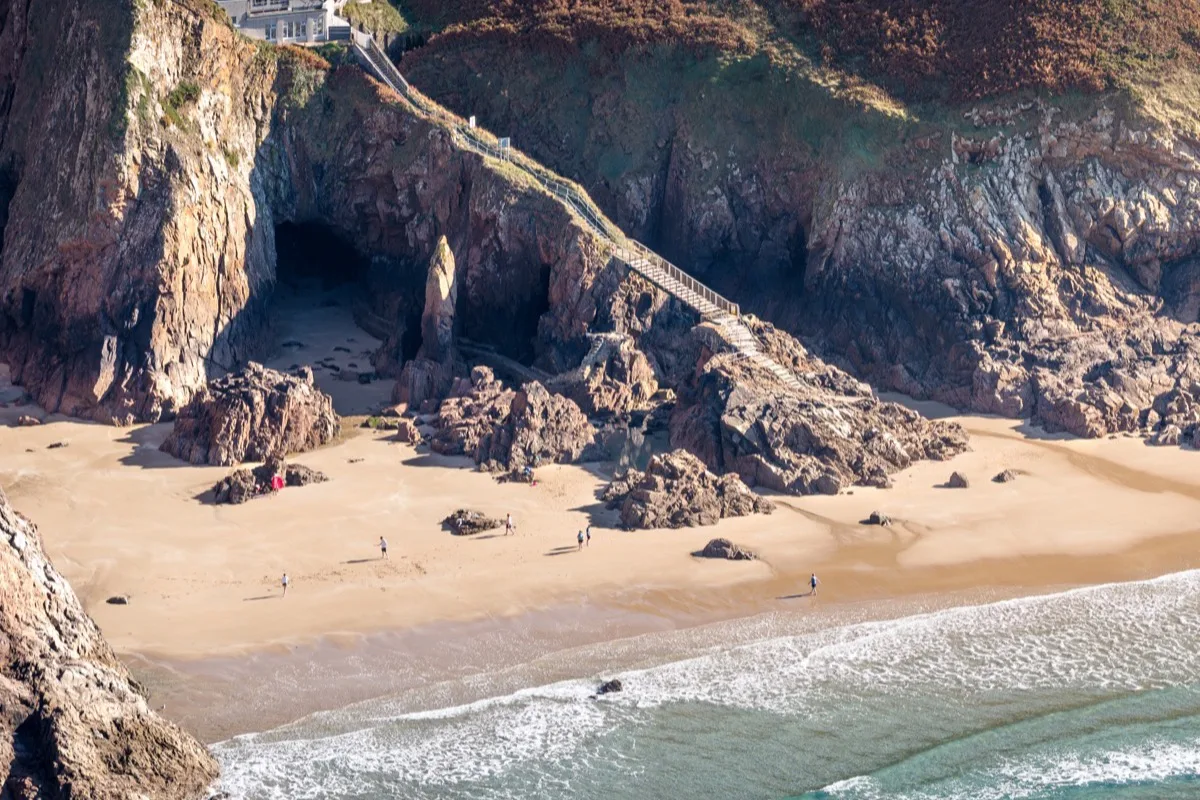
The beach changes more completely with the tide than St Ouen's Bay. At low water there is a broad sandy cove, with rocks, pools and accessible caves around its edges. As the tide rises, the sand contracts rapidly against the cliffs. Around high water, the main beach can be entirely submerged.
A freshwater fall descends from the cliffs after wet weather, although its flow varies considerably.
Plémont is especially tide-dependent. A visit timed close to high water may provide little or no usable beach, even though the bay appears extensive in low-tide photographs.
As the tide falls, sand appears first in the central bay before expanding towards the rocks and caves. Low water reveals the greatest area for walking and exploring. Some caves and rocky recesses are only accessible for part of the tidal cycle.
The return route from the sides of the bay can be narrowed by the incoming sea before the central beach disappears. Anyone entering caves or moving around headlands should watch the water behind them and leave well before their route is threatened.
At high water, visitors usually remain on the rocks and concrete areas near the foot of the access route, provided sea conditions allow. Waves can wash over these areas, so they are not a guaranteed high-tide sitting or swimming platform.
Plémont is sheltered by cliffs from some wind directions, but it remains open to Atlantic swell. Waves can enter the bay and produce surf, shore break and moving water around the rocks.
The fairly steep beach means the water deepens more quickly than on Jersey's broad western and south-eastern sands. This reduces the low-tide walk but can make the edge of the water less forgiving for small children or uncertain swimmers.
Plémont is seasonally patrolled by RNLI lifeguards. The published 2026 hours are 10am to 6pm during the patrol season. Users should swim between the red-and-yellow flags when they are displayed.
Swimming should not be judged solely on the bay looking enclosed. Swell, reflected waves near rocks and rapidly reducing beach space are all relevant.
Plémont is one of the strongest Jersey locations for tide-led exploring. Lower water reveals:
The caves are a low-tide feature, not something available throughout the day. Tide time alone is not enough to judge entry, because swell can send waves into caves even when the predicted tide level is relatively low.
Rock surfaces can be slippery, and falling material is a general possibility beneath steep natural cliffs. Avoid standing immediately below unstable-looking rock faces.
Access is down a long, steep stairway from the cliff-top parking area. There are also steps to the café. The descent and return climb make Plémont unsuitable for wheelchair access and difficult for people with reduced mobility.
There are two car parks above the bay. The elevated viewpoint can still be visited without descending to the beach.
The main facilities are above the beach, so take what you need before descending. Facilities include:
Plémont is one of Jersey's monitored bathing waters. The official profile records two streams entering the bay and warns that water quality may deteriorate during and after heavy rainfall. Each published result is a snapshot from the time it was sampled, not a permanent grade.
No community photos of Plémont Bay yet. Be the first to add one and help build a picture of the beach at every state of the tide.
Add your photoOther bays and beaches close to Plémont Bay.
 North
North West
West North
NorthTides. Tide predictions are forecasts. Actual sea level is affected by atmospheric pressure, wind and waves. Always observe the sea and your surroundings.
Swimming. Sea swimming carries risks: currents, waves, rocks, submerged structures, boats and cold water. This page is for planning and does not confirm conditions are safe. Do not assume the beach is lifeguarded.
Facilities. Facilities and café opening hours change seasonally. Check directly before making a journey specifically to use them.
 Jersey